Certified Translation
Standard, Certified and Legal Translation: Which One Do You Need?
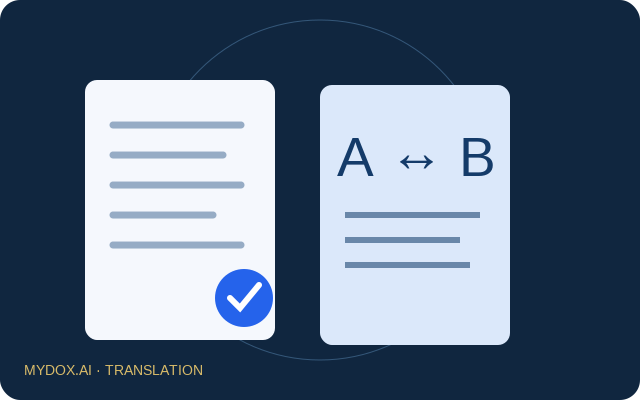
A translated birth certificate looks accurate, but the government office asks for a legally certified version. A company orders legal translation of its entire website even though it only needs clear marketing copy. Both customers have paid for the wrong category of work. The best translation is the one that meets the recipient's actual language and certification requirements.
The short answer: standard translation is usually suitable for general communication; certified translation meets a specified recipient's formal certification requirements; legal translation may require a translator licensed or registered for the relevant jurisdiction and language. The terms are not interchangeable, and certification rules vary internationally.
Choose the translation for its intended use
Before sending a file for a quote, identify who will read it and what the translation must accomplish. A website visitor needs understandable content. A university might require a translation accompanied by a signed accuracy declaration. A court may insist on an appropriately registered legal translator.
Ask for the recipient's written language and certification requirements. If the recipient uses the word “sworn,” “official,” “certified,” or “legal,” confirm what it means in that jurisdiction. The same phrase can refer to different processes in different countries.
Standard translation for everyday and commercial communication
General correspondence, manuals, product descriptions, websites and internal business materials often need accuracy, consistent terminology and an appropriate tone rather than formal authentication. A standard translation should still be professionally reviewed. Poorly translated safety instructions or product specifications can have consequences even if no official certification is required.
Provide the original editable file where possible. Explain the audience, preferred spelling conventions, industry terminology and whether the translated text needs to fit an existing layout. For a multilingual website, provide context for buttons, headings and short labels rather than sending isolated words.
Certified translation for official submissions
A certified translation is prepared in the format required by the recipient, often with a declaration or certification from the translator or translation provider. Requirements can specify who may certify, whether the source document must be attached and whether a signature or stamp is needed.
Typical requests concern academic qualifications, birth or marriage certificates, immigration supporting documents and corporate records. Do not assume that a certificate from any translation company satisfies every official authority. Ask whether the recipient recognizes the particular certification and translator.
Legal translation and UAE registration
Legal translation is not simply translation of a document containing legal language. Where the receiving legal or public authority requires a registered translator, the translator's authorization matters. The UAE Ministry of Justice maintains a translator registration service. Check the language pair and applicable registration before commissioning a translation for a court, notarial procedure or other official use.
Legal documents may include agreements, contracts, court records, notices, powers of attorney, memoranda and articles of association. The translation must preserve obligations, defined terms and references accurately. It does not replace legal advice or create a valid contract if the underlying document is defective.
What changes between the three options?
For a standard translation, the main quality criteria are accuracy, readability and the right terminology. For a certified translation, the recipient's required declaration, format and certification become additional criteria. For legal translation, authorization, jurisdiction, language registration and the treatment of legally significant terminology can be critical.
The extra work required for certification is not automatically useful for every document. Paying for formal certification of a general internal presentation can be unnecessary. Conversely, a fluent but uncertified translation may not be accepted for an official application.
What to provide before requesting a quotation
Send a readable source file and specify the source and target languages. Include the intended recipient, document purpose, deadline and any required certification. State whether the recipient needs an electronic file, printed signed copy or both. If a document contains stamps, handwritten notes or attached pages, include those pages in the review.
Check the spelling of personal names against passports or official identification. Provide the established spelling of company names and addresses. If a word is unreadable, ask how it will be represented rather than allowing a guess.
For a business project, supply a glossary and any existing approved translations. Consistency matters across contracts, corporate presentations and supporting documents, especially when several files refer to the same legal entity.
Practical example: a marriage certificate for UAE use
A customer has an overseas marriage certificate written in a language other than Arabic and needs it for a UAE application. The first step is to ask the receiving authority whether translation is required and in what format. Next, determine the authentication route for the certificate and whether the final stamps or endorsements need to appear in the translated version.
If a UAE-registered legal translator is required, confirm the language-specific availability. Translating too early may mean translating additional authentication pages later. A specialist can help sequence the services, but the authority determines acceptance of the final file.
Another example: an international company website
A company is preparing its website for customers in several markets. Standard translation may be appropriate, together with localization of terminology, examples, units and customer-facing instructions. Formal legal certification of every page is not usually the key issue unless a particular recipient requires it.
Contracts, privacy notices or regulated product statements may need additional specialist or legal review. Identify these separately rather than treating the whole website as one undifferentiated translation order.
A six-step workflow
- Identify the audience, receiving authority and required language pair.
- Review document length, clarity, layout and certification requirements.
- Select the appropriate translation category and confirm translator availability.
- Obtain a quotation describing scope, format and estimated delivery.
- Coordinate translation and quality review, including names and terminology.
- Check the final file against the recipient's instructions and retain the source version.
Do not mix drafts and final versions. If the source document changes after translation begins, tell the translator which paragraphs changed. A version number or date can prevent older clauses from appearing in the final file.
Pricing factors and expected delivery
Translation charges can depend on language pair, length, complexity, formatting, urgency and the required certification. A one-page handwritten record can require more review than a longer editable text. Ask whether stamps, attachments, formatting and any certified printed copies are included.
Timing depends on source quality, specialist availability, length and review requirements. A short document in a less commonly available registered language pair may take longer to arrange than a routine general translation. Do not assume that a wide language network guarantees immediate availability.
Common mistakes
Avoid choosing a translation category based only on price. Confirm whether the translator is authorized where required. Do not omit pages or stamps that the recipient expects to be included. Check names carefully and retain the original digital file.
Machine translation can help someone understand the general meaning of a document, but a machine-generated draft alone does not satisfy a recipient's requirement for a qualified or registered translator. Confidential documents should be shared only through an appropriate secure workflow.
How MYDOX.AI helps
Our certified translation service coordinates standard, certified and legal translation across a wider network supporting 100+ languages, subject to availability. Examples include Arabic, English, French, German, Spanish, Italian, Russian, Chinese, Hindi, Urdu, Bengali, Portuguese and Turkish. This does not mean every language is available through a UAE MOJ-registered translator.
In chat, identify your language pair, document and recipient. A human specialist reviews the certification requirements and confirms the available translator and quotation. For associated document attestation or notary assistance, the specialist can help establish the correct sequence.
Frequently asked questions
Does a certified translation always need a stamp?
The recipient determines the required certification format; it may involve a stamp, signature or another accepted method.
Can any translator translate a court document for official use?
Where registration is required, use a translator authorized for the applicable jurisdiction and language.
Should I translate before or after attestation?
Ask the recipient and relevant authority. The translation may need to include later stamps or endorsements.
Is a notarized translation the same as a legal translation?
No. Notarization and translator authorization address different requirements.
Can I request a quote without visiting an office?
Yes. Begin in chat with the language pair and document details. Physical copies or originals may be needed depending on the recipient.
Need help with your request?
Ask the MYDOX.AI Assistant about this guide. A human specialist can review your requirements and prepare a personalized quotation.